

India’s FDI story in 2025 is no accident. It reflects deliberate policy choices, targeted incentives, and improvements in ease of doing business that, together, attracted meaningful, fresh capital. For companies scouting India as a market or planning expansion, the headline numbers matter, but the policy shifts behind them are more significant.
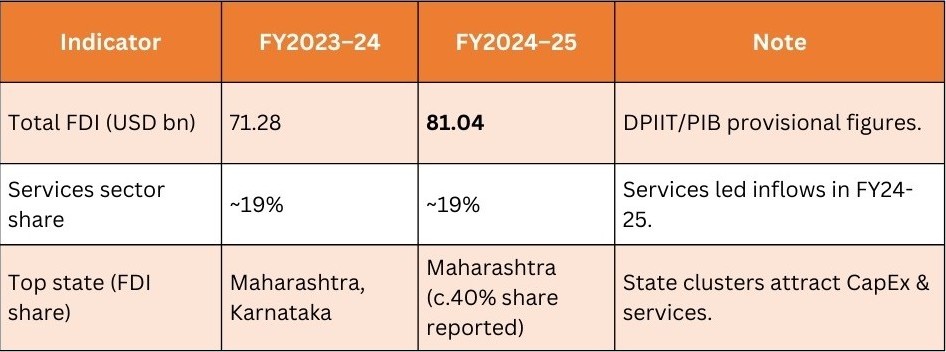
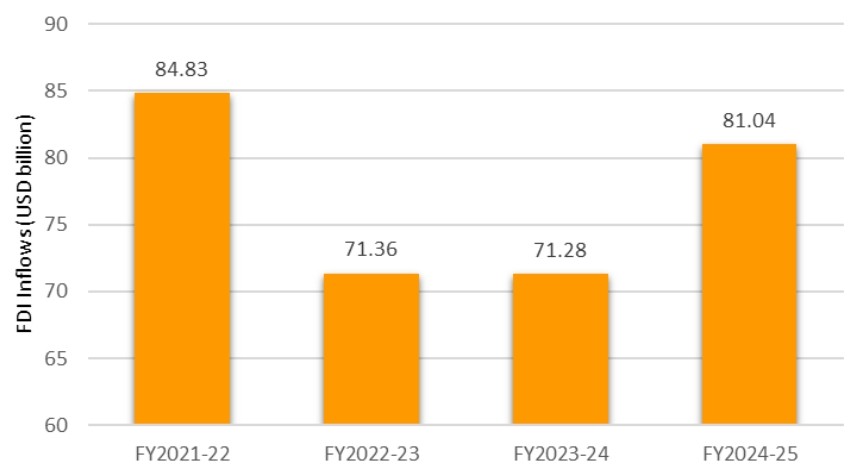
India recorded USD 81.04 billion in FDI inflows for fiscal year 2024–25, a notable rise from the previous year and a strong signal of investor confidence. In the early months of FY 2025–26, equity inflows (April–June) continued to show momentum, with FDI equity rising about 13–15% year-on-year in Q1, indicating sustained interest across services and tech-related sectors.
Why this matters now
- Policy clarity: Faster approvals and consolidated FDI policy guidance reduced time-to-market.
- Targeted incentives: Production-linked incentives and sectoral pushes (electronics, renewables, semiconductors) made India attractive for capital-intensive projects.
- State champions: States with clear land, port and power advantages, notably Maharashtra and Gujarat, captured a large slice of inflows. Maharashtra alone reported a disproportionately large share of FY24-25 FDI.
Top-line table: what changed (FY24-25)
A few pragmatic takeaways for market-entry teams:
- Focus on sector fit, not just headline rates. Energy, semiconductors, finance and digital services are where incentives and private capital meet.
- Evaluate state ecosystems, ports, power, land parcels, and labour availability, as these factors materially affect capex timelines and costs. Maharashtra and Gujarat remain high-priority for many investors.
- Plan for local partnership and compliance. Faster approvals come with stricter local content and operational conditions in some schemes; align supply-chain planning accordingly.
- Use the Q1 FY26 trend to time second-mile investment: early equity and reinvested earnings show that greenfield and expansion projects continue to receive backing.
Below is a concise visual of recent FDI inflows to contextualise the surge.
Services & tech: Continued strength in services reflects global demand for IT and business process services; digital economy policies have helped.
Manufacturing push: PLI programmes and improved infrastructure are nudging global firms to localise manufacturing, increasing FDI quality (capex + jobs).
What market entrants should prioritise
The 2025 FDI boom is a doorway, not a guarantee. Companies that win will pair a clear India strategy with pragmatic execution: choosing the right state, understanding the incentive strings, embedding local partners, and sequencing investments to align with policy windows. For businesses serious about India entry, the opportunity is real, and the competitive edge will come from preparation, not luck.