

A Comprehensive Analysis of the Four Labour Codes.
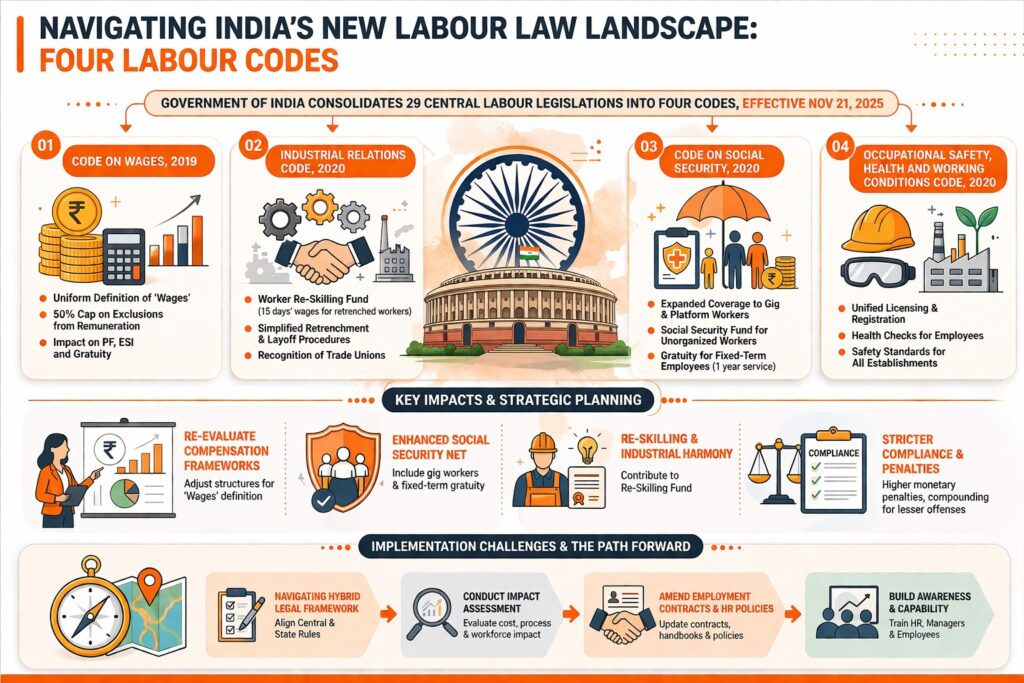
The Government of India has initiated a monumental reform of the country’s labour law framework, consolidating twenty-nine diverse and often archaic central labour legislations into four comprehensive Codes. This paradigm shift, effective from 21st November 2025, aims to simplify the complex legal web, enhance the ease of doing business, and simultaneously fortify the rights and social security of the workforce. The four new statutes: the Code on Wages, 2019; the Industrial Relations Code, 2020; the Code on Social Security, 2020; and the Occupational Safety, Health and Working Conditions Code, 2020 collectively represent the most significant overhaul of Indian labour jurisprudence in decades. This article provides a concise analysis of the key changes introduced by these Codes and their far-reaching implications for employers, employees, and the industrial ecosystem at large.
The Cornerstone of Change: The Unified Definition of ‘Wages’
Perhaps the most transformative aspect of the new regime is the uniform and expanded definition of “wages” across all four Codes. The new definition mandates that certain specified exclusions such as house rent allowance, overtime allowance, statutory bonus, and employer contributions to provident or pension funds cannot exceed 50% of the total remuneration. If these exclusions surpass the 50% threshold, the excess amount will be deemed part of the wages. This singular change has a profound cascading effect on the financial obligations of employers. The computation of critical employee benefits, including gratuity, leave encashment, retrenchment compensation, and statutory contributions to the Employees’ Provident Fund (EPF) and Employees’ State Insurance (ESI), will now be based on this higher wage base. Consequently, organisations must meticulously re-evaluate and potentially restructure their compensation frameworks to ensure compliance and accurately account for the increased financial liability. This redefinition moves beyond mere semantics, fundamentally altering the cost-to-company structures and demanding immediate strategic financial planning from all establishments.
Expanding the Ambit of Social Security and Employee Benefits
The Code on Social Security, 2020 (SS Code) significantly broadens the social safety net for India’s workforce. One of its most notable provisions is the extension of gratuity benefits to fixed-term employees. Under the new regime, fixed-term employees are entitled to receive gratuity upon the completion of just one year of service, a stark departure from the five-year continuous service requirement applicable to permanent employees under the erstwhile Payment of Gratuity Act, 1972. This provision promotes parity and discourages the use of fixed-term contracts as a means to circumvent statutory obligations. Furthermore, in a landmark move to address the realities of the modern economy, the SS Code formally recognizes “gig workers” and “platform workers” for the first time under Indian law. It empowers the Central Government to establish a dedicated Social Security Fund for these workers, to be financed through contributions from aggregators, which are proposed to be between 1% to 2% of their annual turnover. While the precise mechanisms are yet to be notified, this inclusion marks a critical step towards formalizing the gig economy and extending social security protections to a rapidly growing segment of the workforce that previously operated outside the traditional employer-employee paradigm.
Redefining Employment Relationships and Industrial Relations
The new Codes have also widened the scope of key definitions, thereby extending statutory protections to a larger group of individuals. The definition of an “employee” has been broadened to include persons engaged in supervisory, managerial, and administrative capacities, who were previously excluded from the protections of several labour laws. Similarly, the definition of an “employer” is now more inclusive, explicitly covering contractors and the legal representatives of a deceased employer, ensuring greater accountability throughout the employment chain. The Industrial Relations Code, 2020 (IR Code) introduces the concept of a “Worker Re-Skilling Fund.” Employers retrenching a worker will be required to contribute an amount equivalent to fifteen days of the worker’s last-drawn wages to this fund. The fund is intended to provide retrenched workers with financial support for training and re-skilling, thereby facilitating their transition to new employment opportunities. This provision reflects a progressive approach towards managing the consequences of industrial restructuring and technological displacement.
A New Compliance and Penal Paradigm
While the Codes aim to simplify compliance, they simultaneously introduce a more stringent penalty regime for non-compliance. The monetary penalties for various offences have been significantly increased compared to the previous laws, acting as a stronger deterrent. However, the Codes also introduce a mechanism for the compounding of certain offences, allowing for the settlement of violations by paying a specified percentage of the maximum prescribed penalty. This balanced approach reserves imprisonment for the most serious offences while providing a pathway for rectifying less severe infractions, thereby promoting a culture of compliance over punitive action.
Implementation Challenges and The Path Forward
Despite the Codes coming into effect on 21st November 2025, a significant implementation challenge remains. The effective operationalization of these Codes is contingent upon the notification of supporting Rules by both the Central and respective State Governments. As of the effective date, a majority of states have yet to finalize and notify these crucial Rules. In this interim period, as per the General Clauses Act, 1897, the existing rules under the repealed legislations will continue to apply to the extent that they are not inconsistent with the provisions of the new Codes. This creates a complex compliance environment where businesses must navigate a hybrid legal framework. It is imperative for all establishments to conduct a thorough impact assessment, seek expert legal counsel, amend employment contracts and HR policies, and reconfigure their payroll and compliance systems to align with the new legal mandate.
Conclusion
The four new Labour Codes represent a transformative and ambitious legislative endeavour to modernize India’s labour laws. By seeking to balance the interests of both industry and labour, the Codes aspire to create a more dynamic, equitable, and efficient labour market. The journey ahead will undoubtedly involve interpretational challenges and operational adjustments. However, the long-term vision is clear: to foster an environment that supports economic growth while ensuring the welfare, safety, and social security of every worker. Proactive engagement and diligent compliance will be the keys for all stakeholders to successfully navigate this new era of industrial jurisprudence in India.